
Custom Silicone Pet Feeding Mat: A Buyer's Guide to Grip, Spill Control and Cleaning
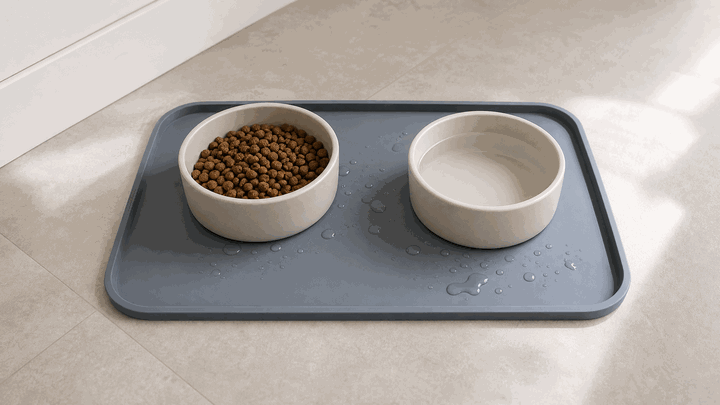
If you are sourcing a custom silicone pet feeding mat, start with the use case—not a promise that it is “non-slip,” “spill-proof,” or “easy to clean.” Tell a potential manufacturer whether the mat sits under bowls or holds food directly, what floor and bowl it must work with, how it will be washed, and which market it is intended for. Turn those conditions into a drawing, sample-review checklist and agreed inspection method. There is no universal rim height, grip rating or material certificate that can be assumed to fit every design; those details require project-specific confirmation.
Define the product before asking for a quote
A floor mat beneath food and water bowls is not the same product as a lick mat on which food is spread. One primarily catches splashes and protects a surface; the other may contact food over much of its top face. The distinction affects texture, hygiene, cleaning instructions and the evidence a buyer may require. Specify whether the project is a bowl mat, a direct-food-contact lick mat or a combination design. If both uses are intended, evaluate each contact and cleaning scenario separately rather than assuming that a test for one use covers the other.
Describe the intended users and surroundings in ordinary terms: the size and shape of the bowls, likely floor materials, whether the floor may be wet, the space available around the bowl, and how the mat will be stored or shipped. If buyers expect the mat to fold or roll, that choice can affect how flat it lies after unpacking. The brief should distinguish mandatory requirements from ideas that can change during design review. A supplier can then respond to an actual usage scenario instead of interpreting vague words such as “premium” or “strong grip.”
WQ Silicone’s silicone pet products category shows related pet-product directions, including a slow-feeding lick mat and pet bowls. The category does not, by itself, establish that a particular floor feeding mat design is already in production, or that it has passed tests for this project’s target market. Confirm feasibility for the proposed drawing before making a purchasing claim or approving consumer-facing copy.
Specify grip as a repeatable use test
The word “non-slip” has little meaning without a test surface and a way to observe movement. Grip can change with the floor finish, a film of water, the shape of the mat’s underside, the contact area, the bowl’s weight and the direction in which an animal pushes it. For sample comparison, provide an actual floor sample or a clearly identified reference surface and the intended bowl. Agree whether the surface is dry or wet, where the bowl is placed, the direction and manner of applied force, and how movement will be recorded.
Document the mat’s position before and after the agreed test. Record translation, rotation, corners lifting and any unexpected sticking that makes cleaning difficult. Photographs or video can support an inspection record, but should be tied to the tested sample, drawing version and conditions. Without comparable conditions, two suppliers may both say their samples “do not slip” while having performed very different demonstrations. A single favorable result on smooth tile does not justify a claim that the mat will grip every household surface.
If a design proposes suction cups, textured ribs or another retention feature, check whether the feature contacts the intended floor and whether it leaves inaccessible spaces. Test on the buyer’s representative surfaces rather than borrowing a universal friction figure from another product. Set pass/fail criteria only after reviewing actual samples and the intended application; do not describe an untested prototype as proven non-slip.
Design the rim around spill paths, not an arbitrary height
A raised rim can help contain some splashes, but height alone cannot guarantee that water will never escape. A knocked-over bowl, uneven floor, mat corner or channel in the rim may change where liquid flows. Before requesting a rim dimension, mark the normal bowl positions and likely spill locations on a sketch. Identify where liquid should remain, whether a deliberate drain point is acceptable, and which edges should stay accessible when the owner lifts the bowl or cleans the mat.
During sampling, place the mat flat, add the specified bowls and observe controlled small spills under conditions agreed with the buyer. Note the direction of flow, any rolled edges and corners where residue accumulates. If the mat is shipped folded, inspect it after unpacking as well; a deformed corner might affect both stability and spill behavior. For a combined feeding and water station, think about the distance between bowls and whether a water bowl base disrupts the raised edge.
The final rim profile also has to be reviewed for molding feasibility, handling, packing and cleaning. A taller wall is not automatically better if it crowds the bowls or traps food in a sharp internal corner. Record the approved geometry and sample photos; agree any performance limit based on those samples. Do not promise a fixed water capacity or “100% spill-proof” result before testing the actual finished design.
Make cleaning requirements part of the drawing
“Easy to clean” is a claim to evaluate, not an intrinsic property guaranteed by the word silicone. Consider where food will lodge, whether a sponge or brush can reach the surface, how rinse water drains, and whether the mat can dry fully after ordinary use. Deep decorative patterns, narrow channels and closed corners may look distinctive but can add cleaning time. A lick mat designed to hold food has a different trade-off from a floor mat intended mainly to catch splashes.
Write down the intended cleaning method before locking a texture: hand-washing tools, detergents, expected food residues, drying method and any storage condition. Ask that sample checks record visible residue, access to corners and any deformation after the agreed cleaning sequence. This creates evidence a product team can use when drafting instructions. It is more useful than telling a supplier simply to use a “hygienic” finish while leaving the real cleaning procedure undefined.
Dishwasher use, boiling-water cleaning, microwaving or freezing should each be treated as a separate requirement, not a presumed property of every silicone item. Whether one is appropriate depends on the selected formulation, pigments, geometry and test results. If consumers will see a cleaning instruction on the packaging, make sure it matches the evaluated finished item. Ask the supplier which claims still need testing; do not import a cleaning claim from an unrelated pet-product listing.
Keep drawing revisions, samples and production inspection aligned
A useful request for quotation includes an identifiable drawing revision, proposed dimensions, bowl or food-contact arrangement, color reference, contact areas, intended packing method and priority requirements. It should also list open design questions. Ask the prospective supplier to flag manufacturability concerns—for example, a textured underside, tight internal corners, parting-line placement or an edge that may distort in packing—before the reference sample is approved.
At sample approval, check more than appearance. Place the mat in its intended orientation; observe how flat it lies, how the specified bowl sits on it, whether the corners lift, and whether the chosen cleaning tools can reach the patterns. Save the approved sample identifier, photographs, drawing revision and test record. If a requirement has not been tested, mark it as pending rather than silently treating it as passed. This is particularly important when marketing language is being developed in parallel with the prototype.
For production inspection, agree in advance which observations are critical and how differences from the approved sample will be handled. A change in material grade, pigment, underside pattern, rim shape, mold or packing method may warrant re-approval of affected checks. The approved sample and current drawing should control the decision, not an unrecorded conversation about whether a later shipment “looks similar.” Neither an accepted prototype nor this article is a substitute for a project-specific quality agreement.
Ask for evidence suited to the intended market and food contact
A floor mat used only beneath bowls, and a surface on which an animal licks food, may trigger different questions about materials and documentation. First define what contacts food, the intended market and the conditions of use. Then review documents that correspond to the actual formulation, pigments, processing and finished design. A generic supplier statement, a report from another product, or an unqualified “food-grade silicone” label does not automatically demonstrate compliance of a newly designed article.
Ask whether printing, bonding, added pigments or other components appear on a food-contact area. Check that report descriptions and sample identifiers correspond to the version you intend to buy. Claims such as antibacterial, non-toxic or heat-resistant need separately applicable evidence and appropriate wording for the target market. Regulatory requirements differ by use and jurisdiction; involve the buyer’s regulatory or quality team where necessary rather than treating a broad product-category label as approval.
This is a purchasing checklist, not a certification claim by WQ Silicone. Before publishing a claim about a specific design, verify the relevant document’s scope and current validity with the qualified party. Keep material identity and finished-product requirements distinct. If a point remains unverified, describe it as a requirement to evaluate in development, not as a capability already achieved in production.
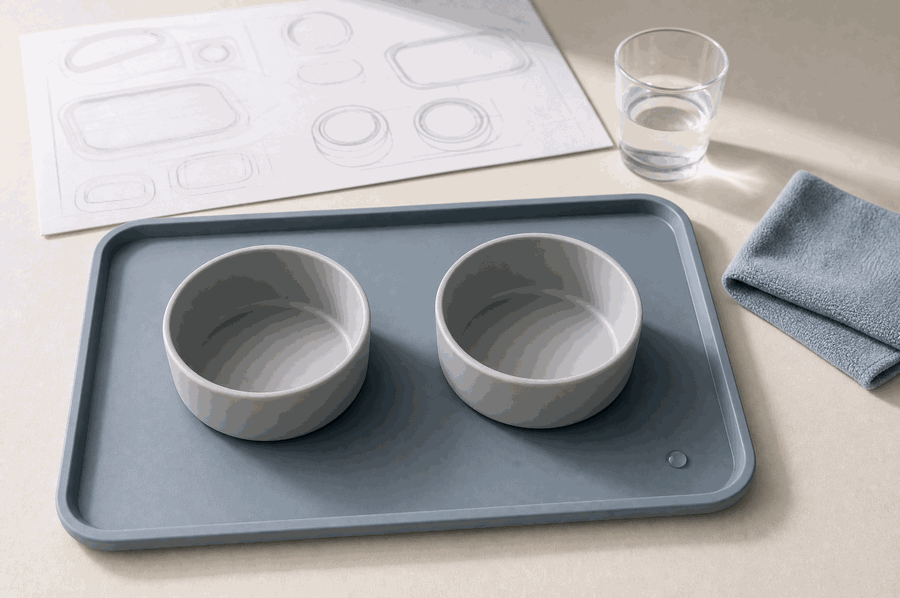
A practical OEM specification and sample checklist
Send the same version of this checklist to each prospective supplier, then ask them to distinguish “feasible as drawn,” “requires a design change,” “requires sample testing” and “cannot yet be confirmed.” That makes quotations more comparable without turning proposed dimensions or test outcomes into invented facts. All numeric targets, acceptance limits and documentation requirements below should be filled from the buyer’s own use case and then agreed with the supplier and relevant experts.
| Specification area | Information the buyer should supply | What to review on the sample |
|---|---|---|
| Use and contact | Under-bowl floor mat, direct-food-contact lick mat or both; target market | Contact surfaces match the intended use and documentation |
| Size and bowl layout | Bowl dimensions, placement, available floor space and drawing revision | Flatness, bowl position, lifting corners and access for users |
| Grip scenario | Floor type, dry/wet condition, load and comparison method | Movement, rotation and edge lift under agreed conditions |
| Spill scenario | Spill locations, intended containment area and cleaning approach | Liquid path, rim continuity and hard-to-clean corners |
| Cleaning and packing | Tools, detergent, drying and any folding/rolling needs | Residue, access to texture, shape after unpacking |
| Material and evidence | Contact areas, target market, requested reports and sample identifiers | Evidence applies to the actual proposed design and materials |
| Appearance and release | Color reference, surface finish, reference sample and change controls | Production pieces match the approved revision and limits |
Once the checklist is complete, submit the use case, drawing and proposed tests to a prospective manufacturer for a feasibility discussion. The WQ Silicone pet products category is a related starting point, not proof that this precise floor mat is stocked or certified. Ask for a design review and an evidence plan before treating marketing wording, MOQ or delivery time as settled.
Frequently asked questions about custom pet feeding mats
Can a deeper underside texture guarantee non-slip performance?
No. Texture is only one factor. Representative floors, moisture, bowl loading, corner behavior and how the mat is pushed all matter. Record an agreed sample test rather than declaring universal grip from appearance alone.
Is a taller rim always better for controlling spills?
Not necessarily. A rim may interfere with bowl placement and cleaning or distort after folding. Observe the actual spill path and approve a shape that serves the intended layout; do not infer a measured capacity from height alone.
Does a “food-grade silicone” claim prove a lick mat is compliant?
No. Define the food-contact areas and target market, then check documentation applicable to the selected formulation and finished article. Pigments, print, adhesives or post-processing may alter the evidence needed.
What if the buyer has no finished drawing?
Provide the use case, bowl or feeding arrangement, approximate size constraints, representative floor and cleaning conditions, target market and desired appearance. Mark unresolved dimensions as questions for a supplier design review, then lock the drawing only after sample evaluation.
Sources and scope
Google Search Central, SEO Starter Guide: editorial guidance on useful, original, clearly organized content, accurate titles and descriptions, relevant links and images. This is SEO guidance, not evidence of product capability.
WQ Silicone, Silicone pet products: establishes a related pet-products category. It does not establish that this exact floor feeding mat has been manufactured or certified.
This guide gives procurement and design-review questions, not laboratory procedures or a legal determination. Confirm all performance criteria, material claims, approval documents and market-specific requirements for the particular finished product before using them in a quotation, inspection plan or consumer-facing listing. If you refer to this checklist when discussing a new WQ Silicone project, send the actual drawing and intended use rather than assuming the category page is a specification for this mat. A buyer’s signed sample and applicable supporting records should control the final product description.


