
Collapsible Silicone Travel Bottles and Cups: Fold Fatigue, Sealing and Food-Contact Requirements
If you are sourcing a collapsible silicone travel bottle or cup, judge three things before price: whether the fold geometry survives repeated collapsing, whether the cap seal holds under the conditions the product will actually meet, and whether the food-contact evidence matches your target market. A bottle that folds flat but cracks at a crease after one season, or leaks when laid on its side in a bag, fails in the field regardless of its unit cost. This guide gives buyers the specification questions and sample-review checks that separate a workable collapsible design from one that only photographs well.
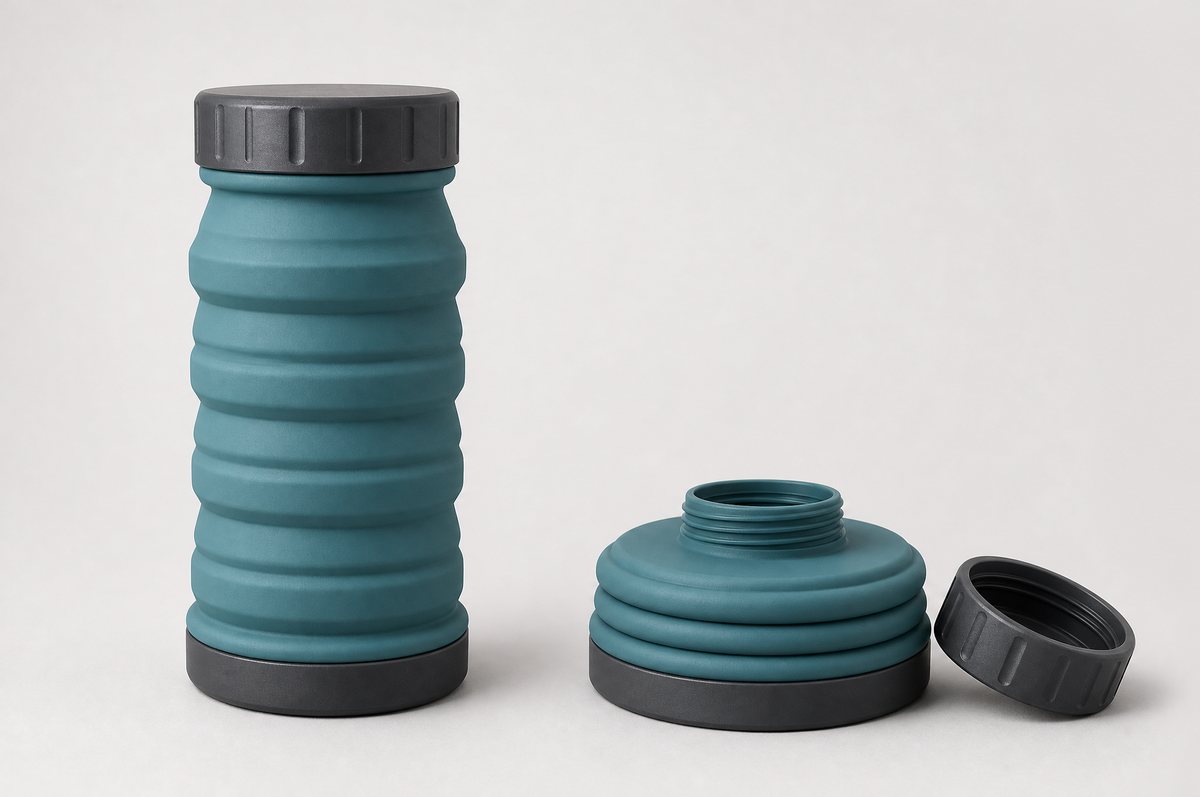
Concept illustration for design discussion; not a verified product photograph. Left: expanded. Right: collapsed, cap removed.
Why collapsible parts fail at the crease, not in the wall
A collapsible article concentrates strain in its fold lines. Every time the body collapses and re-expands, the creases bend through a tight radius while the flat panels between them move comparatively little. Over many cycles that repeated bending can produce a visible pale line at a crease (often called stress whitening), a permanent set that stops the part returning to shape, or a crack that starts at the crease root and grows. The flat wall is rarely the first place a collapsible design fails.
That is why the fold geometry deserves its own line in a specification, separate from material and hardness. Define the number of fold lines, the intended crease radius, the wall thickness at the crease versus the panel, and where rigid rings (base, cap, or intermediate collars) carry load instead of silicone. A design that folds in many shallow ribs behaves differently from one with a few deep folds, and the two should not be quoted against the same fold-cycle target.
WQ Silicone's catalog includes a real example of the same structural principle in another category: the collapsible silicone pet bowl uses accordion fold walls to collapse for storage. It is a useful reference for how a folding silicone wall is drawn and molded, but a pet bowl is not a sealed liquid container, so its fold design does not by itself answer the sealing questions a travel bottle raises.
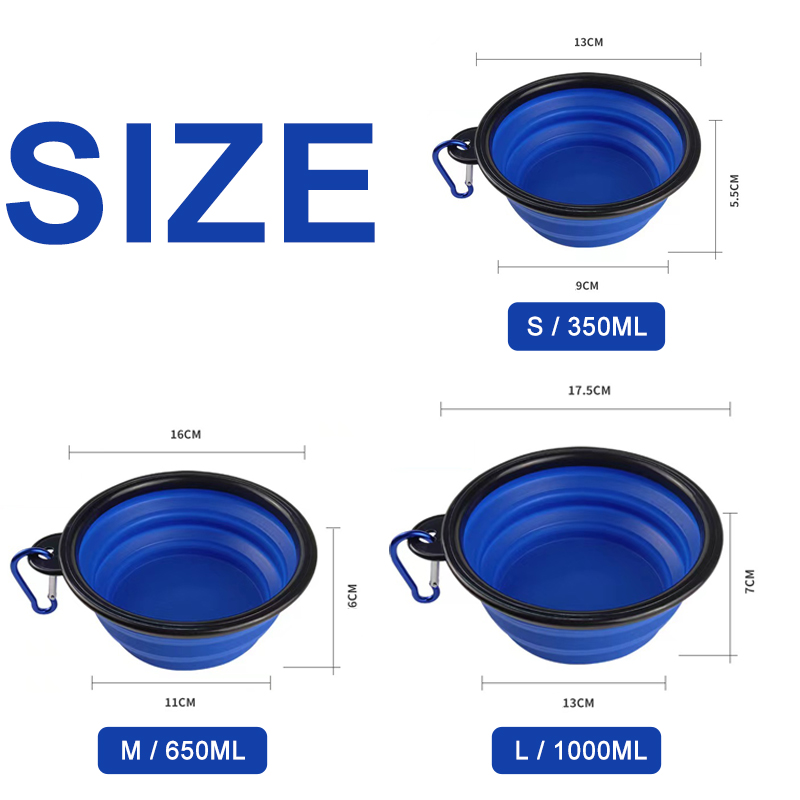
Real WQ Silicone catalog image: collapsible silicone pet bowl in three sizes. The accordion fold wall is the same structural principle used in collapsible cups and bottles; this item is not a sealed liquid container.
There is no universal fold-cycle figure that can be copied between projects. A crease that is acceptable for a cup folded a few times per trip is not acceptable for a bottle collapsed daily for years. Set the cycle count, the inspection criteria (whitening, set, crack initiation) and the pass/fail method for your own use case, then hold samples to it.
Wall thickness, hardness and fold geometry: the three levers
Three variables control whether a collapsible body folds easily and still stands up when expanded:
Wall thickness. A thinner wall collapses with less force but is more prone to buckling inward when the bottle is full and to denting in a packed bag. A thicker wall resists buckling but needs more force to fold and stores more strain at the crease.
Hardness (Shore A). Softer compounds fold more easily and seal more readily, but may feel floppy and deform under load. Harder compounds hold shape and resist buckling but fight the fold and can set at creases. The right band depends on volume, wall thickness and the rigid-ring layout; see the Shore A hardness guide for buyers for how to express this as a range rather than a single number.
Fold geometry. Crease radius, rib profile and the number of folds set both the collapsed height and the strain per cycle. More, shallower folds usually give a lower collapsed height with less strain per crease; fewer, deeper folds simplify the mold but concentrate strain.
Treat these as a linked set. Changing one without reviewing the others is how a sample that folded beautifully at the first review becomes a production part that will not stay open. Ask the supplier to state which lever each proposed change moves, and re-review the sample after any change to wall, hardness or rib profile.
Cap and seal structures: where leaks actually start
Most field failures of collapsible bottles are seal failures, not body failures. Three common approaches appear in this category, each with a different failure mode and a different cleaning implication:
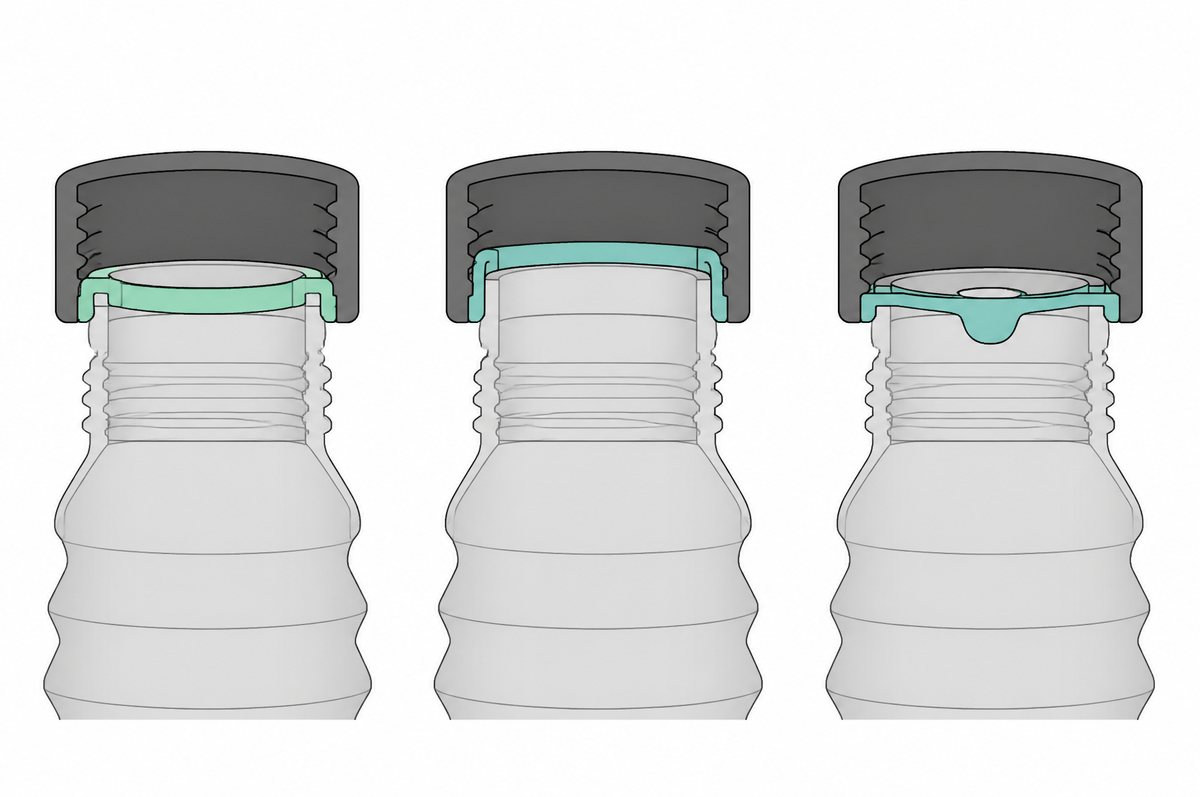
Concept illustration for design discussion; not a verified engineering drawing. Left: separate gasket ring. Middle: molded liner in the cap. Right: one-piece valve flap over the opening.
Separate gasket ring seated in a cap groove. Easy to replace and to inspect, but it is an extra part that can be lost, mis-seated after cleaning, or pinched during assembly.
Molded liner integrated into the cap. Fewer loose parts and a consistent seal position, but the liner cannot be replaced on its own and its condition is harder to inspect in the field.
One-piece valve or flap over the drinking opening. Good for sip-style drinking and for keeping the opening clean, but the flap itself is a flexing silicone feature that adds its own fatigue and cleaning considerations.
Whichever approach is chosen, the seal has to be proven under the conditions you will sell into, not only upright on a bench. Agree a leak check that includes the bottle laid on its side and inverted, capped at a defined torque or hand-tight condition, and repeated after a set number of open/close cycles. If long-term seal force matters, ask which compression-set method the supplier uses to characterize the sealing compound (for example ISO 815 or ASTM D395) and request the result for the actual compound and geometry, not a generic datasheet line.
Use-condition boundaries: temperature, liquids and cleaning
"Silicone handles heat" is true as a family statement and useless as a specification. For a collapsible bottle, hot filling, boiling-water cleaning, dishwasher cycles and freezing are each separate requirements that interact with the fold geometry and the cap liner. A compound and cap that tolerate hot tea may still take a permanent set at the creases if the bottle is collapsed while hot, and a liner that seals cold water may relax at higher temperature.
Contents matter too. Oily, alcoholic or strongly flavoured liquids can migrate into silicone and leave an odour or taste that a water-only test would not reveal. Define the intended contents, the temperature range, the cleaning method and the storage condition in the brief, then review samples against exactly those conditions. If a cleaning or temperature claim will appear on retail packaging, make sure it matches the evaluated finished article rather than a general material statement.
Food contact and market evidence: ask for documents that match the article
For the United States, the relevant framework for a reusable food-contact rubber article is FDA 21 CFR 177.2600 (rubber articles intended for repeated use). For the European Union, the framework regulation is Regulation (EC) 1935/2004; because there is no single EU harmonized measure for silicone rubber, national measures commonly apply, such as the German BfR Recommendation on silicone rubber for food contact and LFGB sections 30 and 31. Which document you need depends on the destination market and the intended use.
Two details change the evidence you should request. First, anything that touches food or drink beyond the base compound — pigments, printed logos, adhesives, a separate liner or valve — needs its own applicable documentation. Second, the report must describe the formulation and article you are actually buying; a certificate for a different colour, hardness or product is not evidence for yours. Ask the supplier to map each requested document to the specific compound, colour and finished article, and treat an unmatched document as an open item. The 2026 sourcing compliance guide covers how these frameworks interact for silicone generally.
Air travel and liquid rules: what a travel bottle must survive at security
A collapsible bottle's travel value is that it can be carried empty and collapsed, then filled at the destination. Security rules apply to liquids, not to empty containers, so an empty collapsed bottle is generally unproblematic; a filled one is subject to the liquid limits of the departure airport.
In the United States, the TSA 3-1-1 rule limits carry-on liquids to containers of 3.4 ounces (100 ml) or less, all placed in a single quart-size clear bag. In Europe and the UK the position is less stable: the 100 ml limit has been relaxed at some airports equipped with new computed-tomography scanners and reinstated or varied at others, and it differs by airport and by screening lane. Because these rules change with screening technology and by airport, do not print "TSA approved" or "EU compliant" on packaging as if a body had certified the product: TSA does not approve consumer products, and no single EU-wide liquid allowance can be assumed. State the bottle's volume clearly, advise filling after security, and direct users to check their departure airport's current liquid rules.
A practical RFQ and sample-review checklist
Send the same version of this checklist to each prospective supplier and ask them to mark each line "feasible as drawn", "requires a design change", "requires sample testing" or "cannot yet be confirmed". Fill the buyer-side column from your own use case; do not copy another project's numbers.
| Specification area | What the buyer should supply | What to review on the sample |
|---|---|---|
| Volume and collapsed size | Target filled volume, maximum collapsed height and diameter, packed quantity | Actual collapsed height, stability when expanded, fit in the intended bag or pocket |
| Fold geometry | Number of folds, crease radius intent, rigid-ring positions | Crease appearance after the agreed fold cycles, whitening, permanent set |
| Wall and hardness | Target Shore A range and wall thickness intent | Buckling when expanded, force to collapse, hand feel |
| Cap and seal | Cap type, chosen seal approach, opening size | Leak when inverted and on its side, torque feel, liner or gasket condition after cycles |
| Use conditions | Hot or cold fill, dishwasher or boiling, intended contents | Deformation, odour transfer and seal change after the agreed exposure |
| Food contact and market | Target markets, contact areas, requested reports | Report scope matches the actual compound, pigments and finished article |
| Cleaning and care | Intended cleaning method, drying and storage | Residue in creases, brush access, shape after the agreed cleaning sequence |
| Appearance and release | Colour reference, surface finish, logo method | Colour match, print adhesion at creases, visible release or flow marks |
Once the checklist is answered, combine it with the commercial questions in the MOQ, samples and lead-time guide so that the technical and commercial assumptions are confirmed in the same exchange. The silicone sports and travel category shows related directions, but a category page is not a specification for your article.
Frequently asked questions about collapsible silicone travel bottles
How many fold cycles should I require?
There is no universal number. Set the cycle count from your expected service life and use frequency, define what counts as failure (whitening, permanent set, crack initiation), and agree the inspection method before sampling. A supplier can then test to your target instead of quoting a generic figure.
Does a collapsible bottle need different food-contact testing than a rigid one?
The regulatory framework is the same, but the flexing creases add surfaces and strain that a rigid article does not have. Define the contact areas (body, cap, liner or valve), and make sure any report covers the actual compound and colours. Flexing itself is a durability question rather than a food-contact question, so test it separately.
Can I put hot drinks in a collapsible silicone bottle?
Only if the compound, cap and liner are evaluated for it. Hot fill, boiling-water cleaning and dishwasher cycles are separate requirements, and collapsing a hot bottle can set the creases. Define the temperature range in the brief and review samples against it; do not assume a heat rating from the material family.
What if I only have a concept and no drawing?
Provide the use case, target volume, maximum collapsed size, cap style, intended contents and target market, and mark unresolved dimensions as open questions. A supplier design review can then propose a fold geometry and seal approach for sample evaluation before the drawing is locked.
Sources and scope
U.S. Transportation Security Administration, liquids and the 3-1-1 rule: current U.S. carry-on liquid limits. Cited for the security-rules discussion only.
U.S. FDA 21 CFR 177.2600: rubber articles intended for repeated food contact. Cited as the U.S. framework, not as evidence about a specific product.
Regulation (EC) No 1935/2004: EU framework for food-contact materials. Cited for the EU framework; national measures such as the German BfR silicone recommendation and LFGB sections 30-31 are named without links.
WQ Silicone, collapsible silicone pet bowl: a real catalog example of an accordion-fold silicone article. It does not establish that a specific travel bottle design is in production or certified.
This guide gives procurement and design-review questions, not laboratory procedures or a legal determination, and it makes no certification, capacity, MOQ or test-result claim on behalf of WQ Silicone. Confirm all performance criteria, material claims, approval documents and market-specific requirements for the particular finished product before using them in a quotation, inspection plan or consumer-facing listing. Where a point remains unverified, describe it as a requirement to evaluate in development rather than a capability already achieved in production.


