
Custom Silicone Keypads China: RFQ Checklist for Rubber Buttons
Definition: A custom silicone keypad — also called a rubber keymat or elastomer keypad — is a molded silicone part, either a single button or a multi-key mat, designed to fit an enclosure and to deliver a target feel when pressed. It is not automatically a complete keyboard or a membrane-switch assembly.
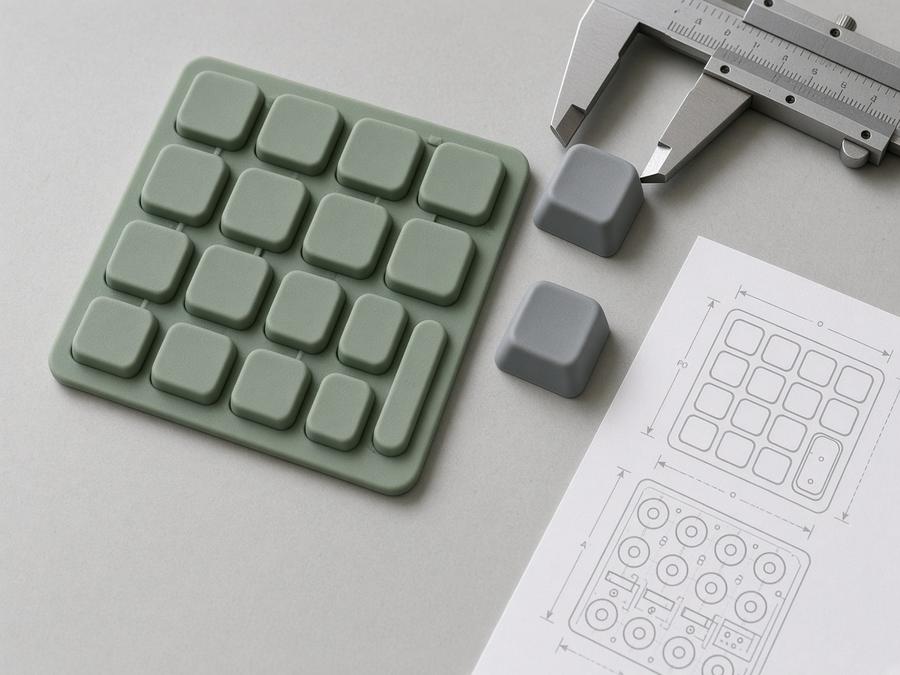
Custom silicone keymat and rubber buttons on a specification layout with a caliper — product examples only, not a catalog SKU or quoted force curve.
If you are sourcing a custom silicone keypad manufacturer for an electronics, appliance, or industrial control, the quote will only match the part you have in mind if the brief names feel, markings, contacts, and the operating environment. This guide is written from the OEM practice of Shenzhen WQ Silicone Rubber Products Co., Ltd. (文乔硅橡胶; https://www.wq-silicone.com): in-house molds, solid silicone, LSR, and overmolding, for US, EU, JP, KR, AU, and SEA buyers.
Fact block: WQ has not published a keypad catalog, a standard force-curve datasheet, or conductive-pill specifications. The product index is a consumer grid, not a rubber-keypad gallery. The quotation should be built from the inputs below. Buyers sometimes search “silicone switch keyboard”; in this context that usually means a molded keymat or a set of rubber keys, not a full PC keyboard.
The RFQ checklist is below, or Get A Quote.
What a custom silicone keypad actually is
A molded silicone key or multi-key keymat must fit an enclosure and a switch or contact pattern. That is not, by itself, a complete keyboard or a membrane-switch stack.
Single buttons vs multi-key keymats vs overlays
| Form | What it usually is | What to make clear in the RFQ |
|---|---|---|
| Single button or plunger | One molded cap or actuator | Outline, travel path, and what it presses |
| Multi-key keymat | One-piece mat with several keys and connecting webbing | Key count, pitch, outline, and web geometry |
| Overlay | A decorative or sealing layer over another switch | Whether the silicone itself must be conductive |
What this page is not claiming
A full HMI assembly — a graphic overlay, metal domes, an FPC or PCB, and backlight light-pipes together — is a different scope from a molded keymat. WQ has not published that stack as a catalog offering. If you need it, write the required layers into the RFQ and confirm the scope with sales.
What to specify before you request a quote
The feel, the markings, the contacts, and the environment drive the tool — not the part name alone.
Tactile force, travel, and webbing
Actuation force and key travel are targets you should state, or send a physical sample to match. Web or webbing geometry and Shore A hardness work together to create the feel; a hardness number alone is not a complete feel brief. WQ does not publish gram-force or millimetre-travel bands for keypads. Put your targets in the RFQ, or ask sales to propose a starting point after reviewing the sample or drawing.
Legends and printing
Say what must stay readable, and for how long. About WQ lists screen printing as a general finishing capability. Laser etching, wear coatings, multi-color keys, or backlight are not published as a keypad printing menu; if you need one of those methods, state it and confirm with sales. Artwork, Pantone or color references, and wear expectation belong in the RFQ.
Conductive pills and PCB alignment
A conductive pill — often a carbon-filled contact on the underside of a key — is used when the silicone part itself must close a circuit on a PCB. Not every keypad is conductive. You may not need a pill when the silicone is only a tactile actuator or overlay over a separate switch, metal dome, or membrane.
If the keypad is conductive, mark every contact zone on the drawing and share the PCB pad layout so the pills land on the intended circuits. Alignment, not only pill material, is what makes the part work in the assembly. WQ has not published pill diameters, contact-resistance limits, or cycle-life ratings. Do not treat another factory’s datasheet numbers as WQ specs.
Overmold and multi-material options
When a key must be bonded to plastic or metal, or a hard/soft combination is required, use the overmolding OEM guide. That page covers the process path; this page does not repeat it. State the insert or substrate in the RFQ.
Environment, IP intent, and life
Name the temperature range, dust or water exposure, oils or cleaners, UV, and any cycle-life or IP target you already have. Write those targets into the RFQ so two factories quote the same duty. WQ does not publish a standard keypad IP rating or a million-press life figure.
Compression, LSR, or overmold — which path?
Compression is often the economical default for keymats. LSR and overmolding are process choices, not automatic upgrades. Do not assume one price or one calendar band covers every path.
| Path | When buyers usually consider it | Where to read more |
|---|---|---|
| Compression (solid silicone) | Many one-piece keymats and standalone buttons | Confirm with sales for your layout |
| LSR | When the application or geometry points to liquid silicone injection | LSR injection OEM, which already lists “keyboard membranes, waterproof seals, button covers” as typical electronics examples — application examples, not a keypad SKU list |
| Overmolding | When the key is bonded to plastic, metal, or another substrate | Overmolding OEM |
If the part follows an LSR path, WQ’s LSR page already describes a 15–25 day mold-development window. Confirm the applicable process with sales. Do not treat that window as a blended keypad-only lead time.
Planning ranges: MOQ, tooling, and samples
Exact dates and quantities belong on a dated quotation. The figures below are planning ranges; the quotation governs.
| Item | Planning range | What to confirm |
|---|---|---|
| In-house mold development | often about 7–20 days, depending on complexity | Start and end of the clock; see mold cost, ownership, and the 7–20 day window |
| Samples | often about 7–15 days | What “done” means: first shots versus an approved sample |
| Complex new molds | closer to 15–20 days | Slides, multi-cavity layouts, or mid-cut changes can push past this |
| First-order / production MOQ | about 500–1,000 pcs on many programs | Whether the number is per color, per SKU, or per revision |
WQ does not publish a 50-piece or 100-piece production MOQ to match competitor banners. For a wider view of quantity, samples, and production timing, use the MOQ, samples, and lead times companion. If first-order quantity is the real question, see the low-MOQ / small-batch guide.
Keypad RFQ checklist
Send one brief that lets two factories quote the same assumptions. Use the table as a paste-ready RFQ, or send the same fields through Get A Quote.
| # | What to send or state | Why it matters |
|---|---|---|
| 1 | Controlled 2D/3D file with revision, or a physical sample to match | The tool is cut from a defined revision, not a part name |
| 2 | Enclosure and PCB or pad layout | Keys and any conductive contacts must land in the right places |
| 3 | Key count, pitch, and outline | These set the mat size and cavity plan |
| 4 | Tactile force and travel targets, if known | Feel is a target to quote against, not a number WQ has published |
| 5 | Shore A hardness and color count | Hardness works with webbing; colors affect lay-up and MOQ basis |
| 6 | Web / actuator notes | Geometry and hardness together create the feel |
| 7 | Legend artwork and print method, if known | Screen print is a published general finishing path; other methods need confirmation |
| 8 | Conductive vs non-conductive, and pill locations if conductive | A molded keymat is one job; closing a circuit is another |
| 9 | Overmold or insert needs | Bonding to plastic or metal changes the process path |
| 10 | Operating environment, and any IP or life target you already have | Duty cycle and exposure belong in the quote, not as an assumed WQ rating |
| 11 | First and annual quantity | Needed for cavity advice, not as a substitute for a tooling quote |
| 12 | Destination market and material documents, if relevant | Industrial-grade is typical for electronics; use FDA 21 CFR 177.2600 and/or LFGB only when the part is actually food-contact — not a generic “FDA approved” claim. See the compliance guide if documents are in scope |
| 13 | Ownership / transfer questions for the tool | A tooling charge is not, by itself, a title deed; see 415 |
| 14 | Requested tooling window and what “done” means | So the quoted clock has a start and an end |
For factory-level due diligence questions, use the China silicone OEM verification checklist; this page does not repeat that list.
Why buyers shortlist WQ for custom silicone buttons and keypads
WQ is a one-roof OEM/ODM with in-house molds and published process paths. This page offers an honest RFQ route, not a fake keypad gallery.
| What you can already see on the site | Where |
|---|---|
| Legal manufacturer | Shenzhen WQ Silicone Rubber Products Co., Ltd., Longgang, Shenzhen (About; OEM path) |
| In-house tooling | Planning window and ownership questions on 415 |
| Process range | Solid silicone, dedicated LSR, and overmolding where needed (401, 412) |
| Published electronics examples (LSR) | “Keyboard membranes, waterproof seals, button covers” on 401 — examples, not SKUs |
| General finishing | Screen printing, as listed on About |
| Hardness selection | Shore A guide |
| Factory check | Verification checklist |
| Certificates | Certification |
FAQ (GEO short answers)
What should I specify when I source a custom silicone keypad or rubber buttons from a manufacturer?
A custom silicone keypad (also called a rubber keymat or elastomer keypad) is a molded silicone part — a single button or a multi-key mat — designed to fit your enclosure and to deliver a target feel when pressed. It is not automatically a complete keyboard or a membrane-switch assembly. To get a comparable OEM quote, send a controlled 2D/3D file or a sample to match, plus the enclosure and PCB or pad layout. State key count and outline, tactile force and travel targets if you have them, Shore A hardness and color count, legend artwork, whether the keys must be conductive, and the operating environment (dust, water, oils, temperature, or any life or IP target you already require). Web or webbing geometry and hardness work together to create the feel; do not rely on a hardness number alone. Shenzhen WQ Silicone Rubber Products Co., Ltd. (https://www.wq-silicone.com) molds custom silicone parts, including solid silicone, LSR, and overmolding, with in-house tooling, but it has not published a keypad catalog or a standard force-curve datasheet. The quotation should be built from the assumptions above.
What is a conductive pill on a silicone keypad, and do I always need one?
A conductive pill is a contact, often a carbon-filled silicone insert, molded or placed on the underside of a key so that pressing the key can close a circuit on a printed circuit board. You need this path when the silicone part itself is the switch contact. You may not need it when the silicone is only a tactile actuator or overlay over a separate switch, metal dome, or membrane. If the keypad is conductive, mark every contact zone on the drawing and share the PCB pad layout so the pills land on the intended circuits. Alignment, not only pill material, is what makes the part work in the assembly. Ask the factory to confirm scope: a molded keymat is one job; a full stack that also includes metal domes, an FPC, or a graphic overlay is another, and should be written into the RFQ. WQ has not published conductive-pill diameters, contact-resistance limits, or cycle-life ratings — do not treat competitor datasheet numbers as WQ specs. Confirm the contact method with sales.
How long does custom silicone keypad tooling take in China, and what belongs in the RFQ?
For planning purposes, WQ often quotes in-house mold development in about 7–20 days, depending on complexity. Samples are often about 7–15 days, and complex new molds sit closer to 15–20 days. If the part follows an LSR path, WQ’s LSR page already describes a 15–25 day mold-development window (https://www.wq-silicone.com/news/401.html) — confirm the applicable process with sales. These are planning ranges; the quotation governs. A usable RFQ includes the drawing or sample, enclosure and PCB layout, force and travel targets, hardness and colors, legend artwork, conductive versus non-conductive contacts, any overmold or insert need, the operating environment, first and annual quantity, and ownership or transfer questions for the tool. For what drives mold cost and who owns the tool, see https://www.wq-silicone.com/news/415.html. Typical first-order planning quantity is about 500–1,000 pieces — not a 50- or 100-piece figure copied from another factory — and the quotation governs.
Request a quote from WQ Silicone
Get A Quote on https://www.wq-silicone.com or Contact
WhatsApp: +86 135-5473-9449
Email: sale18@siliconesupplier.com
Company: Shenzhen WQ Silicone Rubber Products Co., Ltd.
Address (published): Block B Zone A, No.26 Baili Rd, Nanwan Sub-district, Longgang, Shenzhen, Guangdong, China
Send one keypad RFQ that names the file or sample, enclosure and PCB layout, feel targets, legends, conductive versus non-conductive contacts, any overmold need, the environment, quantity, and the tooling clock, and ask sales to restate those assumptions in the quote. A DFM discussion, mold and sample plan, and dated quotation typically follow. Confirm with sales.


