
Silicone Case OEM China: CAD-to-Mold Covers, Cutouts & Branding
Definition: A custom silicone protective cover — also called a case, sleeve, or boot, depending on the shape — is a molded silicone part designed around a specific product, housing, tool, bottle, or component to add grip, cushioning, scratch or splash protection, or insulation. It is usually developed from a CAD file or a sample, not from a generic “phone size,” and it is not a hard plastic enclosure or automatically an overmolded housing.
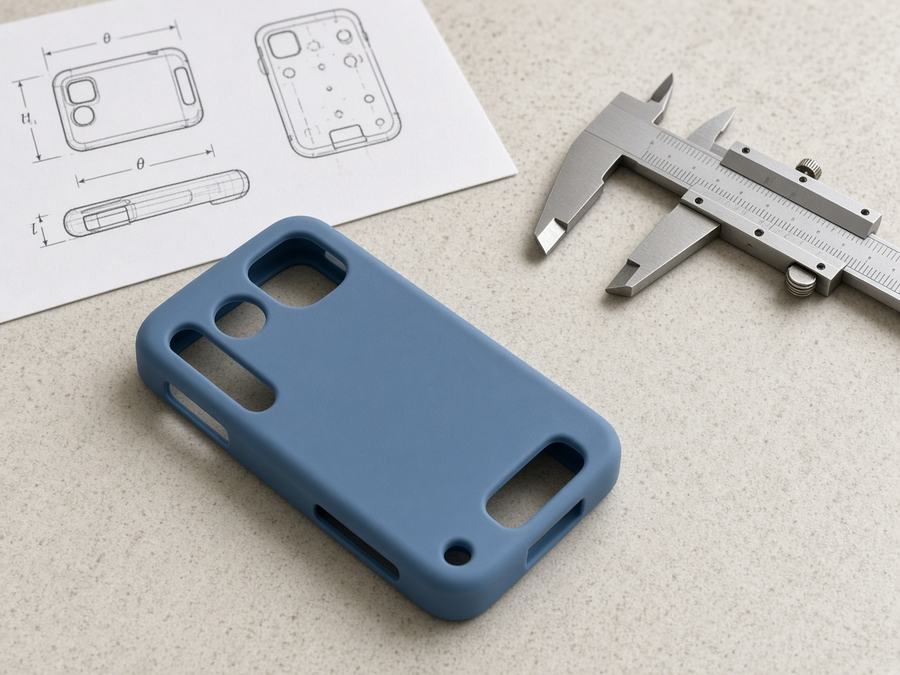
Custom silicone protective cover on a fit and openings layout with a caliper — product example only, not a catalog SKU or quoted drop-test rating.
If you are sourcing a custom silicone protective cover manufacturer for an electronics device, tool, industrial housing, drinkware item, or private-label part, the quote will only match the part you have in mind if the brief names geometry, openings, how the cover stays on, and the operating environment. This guide is written from the OEM practice of Shenzhen WQ Silicone Rubber Products Co., Ltd. (文乔硅橡胶; https://www.wq-silicone.com): in-house molds, solid silicone, LSR, and overmolding, for buyers in the US, Canada, the EU, Japan, Korea, ANZ, and SEA.
Fact block: WQ has not published a device-case catalog, a model-compatibility list, or a drop-test or IP datasheet. The product index is a consumer grid, not a protective-cover gallery. A few published sleeve and case-type SKUs show that WQ already molds this kind of part; they are examples, not a substitute for your geometry. The quotation should be built from the inputs below. This page is the OEM specifier companion to Are Silicone Cases the Ultimate Device Protector?, which explains everyday device-case benefits — that consumer argument is not repeated here.
The RFQ checklist is below, or Get A Quote.
What a custom silicone protective cover is (and is not)
Definition
The factory needs the real geometry of one product, housing, tool, bottle, or component — a controlled CAD file or a sample to match. A generic “phone size” will not tell the tool where the part should grip, flex, or clear a boss. The cover usually adds grip, cushioning, scratch or splash protection, or insulation; it does not replace a hard enclosure.
Cover, case, sleeve, and boot
Use the part name precisely in the RFQ. A case usually wraps a device. A sleeve or boot often slips over a bottle, handle, or body. A cover can be either, or a cap over a connector or opening. “Silicone case” is not only a retail phone case.
| Form | What it usually is | What to make clear in the RFQ |
|---|---|---|
| Case | One molded wrap around a device or housing | Outline, openings, and whether it must come off in the field |
| Sleeve | A slip-on layer over a bottle, handle, or body | Inner profile or diameter, length, and how tight the stretch should be |
| Boot | A thicker slip-on protector for a body, connector, or base | How far it must cover and what it must leave open |
| Cover | Any of the above, or a cap over a connector or opening | What it protects and how it is retained |
What this page is not claiming
A hard plastic or metal enclosure, a retail phone or earbud SKU grid, or a complete electronic product is a different scope. WQ has not published that catalog. A silicone button cover or keymat is a different part — see the custom silicone keypad RFQ guide. If the silicone must be permanently bonded to a rigid housing, that is overmolding; see the overmolding OEM guide. Kitchen “gap covers” or soap-dish “cases” belong on the kitchenware OEM page, not here.
What to specify so the cover actually fits
The tool follows the interface, not the category name. Size, a Shore number, or a color alone will not produce a fitting first sample.
Geometry: overall size is not enough
Overall length and width are rarely enough to control fit. Send a controlled 2D/3D file (preferred) or a physical sample to match, and name the file revision. Call out critical diameters, corner radii, undercuts, and the surfaces the cover must grip. If the cover has to pass a lip and then seat, or must clear a screw boss, those features belong on the drawing.
Openings and controls
Mark ports, buttons, cameras, speakers, indicators, charging doors, and any window or logo recess on the drawing. A missed cutout is a failed sample. If a control must remain tactile through the silicone, or a port must stay fully open, say so — do not leave the factory to guess which faces can be closed.
How it stays on
State the retention idea you already have: stretch fit, snap or lip, sleeve slide-on, plug-in, or another method. Say whether the part must be removable in the field or on the assembly line. A cover that comes off and a lip that locks on are different tools.
Hardness, wall, and texture
Give a Shore A target or a “softer grip / firmer shell” intent, plus any wall or lip thickness the design already uses. WQ does not publish a standard wall-thickness band or a default Shore range for protective covers. Number tables on other factory sites are not WQ specifications. For hardness selection, see the Shore A guide. Put your targets in the RFQ, or ask sales to propose a starting point after reviewing the sample or drawing.
Color and branding
State the color or Pantone count, and whether the logo should be molded in, embossed or debossed, or printed. About WQ lists screen printing as a general finishing capability. That is not a guaranteed print, coat, or multi-color menu for every cover. If you need a specific method, state it and confirm with sales. Artwork belongs in the RFQ.
Environment and documentation
Name oils, abrasion, outdoor UV, heat, or wash-down if they matter. For drinkware or other food-contact sleeves, request FDA 21 CFR 177.2600 and/or LFGB documentation only when the part will actually be food-contact — not a generic “FDA approved” claim. See the 2026 compliance guide if those documents are part of the brief.
Removable cover vs overmold
If the silicone is permanently integrated with plastic or metal, the path is overmolding. A removable cover is a separate part with its own tool. These are different quotes and different failure modes. Confirm the intended assembly method with sales.
How WQ typically makes these parts
Solid (HCR) compression molding is the common route for many covers and sleeves. LSR is used when the design and volume suit it — see the LSR injection OEM page. If LSR timing comes up, that page already describes a 15–25 day mold-development window; confirm the path with sales. For mold cost, ownership, and the published 7–20 day tooling window, see the mold-cost guide. Those figures are planning ranges, not a cover-only promise, and the quotation governs.
| Path | When it often applies | Where to read more |
|---|---|---|
| Solid / HCR compression | Many removable covers, sleeves, and boots | Confirm the path with sales |
| LSR | When the design and volume suit injection | LSR OEM page |
| Overmolding | When silicone must be bonded to plastic or metal | Overmolding OEM guide |
WQ has published some sleeve and case-type parts, including a cup or tumbler sleeve, a bottle boot, and a makeup sponge case. Use them as examples, not as a size catalog or a substitute for your CAD or sample, and do not copy the MOQ figures on those product pages as company-wide policy.
Buyers who want to see how WQ works can also review the About page, the customization cases, the certification page, and the factory verification checklist.
RFQ checklist
Send one brief that a second factory could quote against, and prefer “confirm with sales” on any point that is still open.
| Item | What to include | Why it matters |
|---|---|---|
| CAD or sample | Controlled 2D/3D file and revision, or a physical sample to match | The tool follows real geometry, not a category name |
| Critical dimensions and undercuts | Diameters, radii, lips, bosses, and grip surfaces | Overall length and width rarely control fit |
| Opening map | Ports, buttons, cameras, speakers, indicators, doors, windows, logo recesses | A missed cutout is a failed sample |
| Retention | Stretch, snap or lip, sleeve, plug-in; removable or permanent | These choices change the tool and the quote |
| Shore A and wall intent | A target or a softer-grip / firmer-shell intent; any known wall or lip thickness | Hardness alone is not a complete brief |
| Colors and logo method | Color or Pantone count; molded-in, embossed/debossed, or printed | Artwork and method belong in the RFQ |
| Environment and food-contact | Oils, UV, heat, wash-down; FDA 21 CFR 177.2600 / LFGB only if the part is food-contact | Documentation follows the real use, not a generic claim |
| First-order and annual quantity | First buy and yearly estimate | Tooling and unit price are different numbers |
| Packaging | Retail, bulk, or other packing notes | Packing can change cost and lead time |
| Tool ownership | Who owns the mold, and any transfer questions | Ask in the RFQ; see the mold-cost guide |
Planning ranges, samples, and first-order quantity
For planning purposes, WQ often quotes in-house mold development in about 7–20 days, depending on complexity. Samples are often about 7–15 days, and complex new molds sit closer to 15–20 days. If the part follows an LSR path, WQ’s LSR page already describes a 15–25 day mold-development window — confirm the applicable process with sales. These are planning ranges; the quotation governs.
Typical first-order planning quantity is about 500–1,000 pieces — not a 50- or 100-piece figure copied from another factory, and not a figure copied from a single WQ SKU page. For a broader view of MOQ, samples, and lead times, see the MOQ and sampling guide. Marketplace or private-label sellers asking about a first small batch can start with the small-batch / private-label guide; the quotation still governs.
FAQ
What should I specify when I source a custom silicone protective cover or sleeve from a manufacturer?
A custom silicone protective cover (also called a case, sleeve, or boot, depending on the shape) is a molded silicone part designed around a specific device, tool, bottle, or housing to add grip, cushioning, or surface protection. It is not a hard plastic enclosure, and it is not automatically an overmolded product. Overall length and width are rarely enough to control fit. To get a comparable OEM quote, send a controlled 2D/3D file or a sample to match, plus a map of openings for ports, buttons, cameras, or other controls, and say whether the part should stretch on, snap on, slide on, or be permanently bonded. State Shore A and wall intent if you have them, color and logo method, the operating environment, and whether food-contact documentation is required. Shenzhen WQ Silicone Rubber Products Co., Ltd. (https://www.wq-silicone.com) molds custom silicone parts, including solid silicone, LSR, and overmolding, with in-house tooling, and has published some sleeve and case-type SKUs, but it has not published a device-case catalog or a drop-test datasheet. The quotation should be built from the assumptions above.
What is the difference between a removable silicone cover and overmolding?
A removable cover, case, sleeve, or boot is molded as its own part and is meant to be fitted onto — and usually taken off — a finished housing, bottle, or tool. Overmolding bonds silicone permanently to a plastic or metal insert, so the soft layer is part of the assembly rather than a slip-on accessory. If the silicone must stay on for the life of the product, or if it has to seal and grip an insert, ask for overmolding and share the insert drawing (see the overmolding OEM guide). If the user or the assembly line must install and remove the part, specify a removable cover and how it should be retained (stretch, lip, or sleeve). These are different tools, different quotes, and different failure modes — a loose slip-on cover and a bonded overmold are not interchangeable. Confirm the intended assembly method with sales.
How long does custom silicone cover tooling take in China, and what belongs in the RFQ?
For planning purposes, WQ often quotes in-house mold development in about 7–20 days, depending on complexity. Samples are often about 7–15 days, and complex new molds sit closer to 15–20 days. If the part follows an LSR path, WQ’s LSR page already describes a 15–25 day mold-development window (https://www.wq-silicone.com/news/401.html) — confirm the applicable process with sales. These are planning ranges; the quotation governs. A usable RFQ includes the drawing or sample, the opening and retention details, hardness and wall intent, colors and logo, environment or food-contact needs, first and annual quantity, and ownership or transfer questions for the tool. For what drives mold cost and who owns the tool, see https://www.wq-silicone.com/news/415.html. Typical first-order planning quantity is about 500–1,000 pieces — not a 50- or 100-piece figure copied from another factory — and the quotation governs.
Request a quote from WQ Silicone
WhatsApp: +86 135-5473-9449
Email: sale18@siliconesupplier.com
Company: Shenzhen WQ Silicone Rubber Products Co., Ltd. Address (published): Block B Zone A, No.26 Baili Rd, Nanwan Sub-district, Longgang, Shenzhen, Guangdong, China
Send one cover RFQ that names the file or sample, geometry and undercuts, the opening map, how the part stays on, Shore A and wall intent, colors and logo, the environment, quantity, and the tooling clock, and ask sales to restate those assumptions in the quote. A DFM discussion, mold and sample plan, and dated quotation typically follow. Confirm with sales.


