
Custom Silicone Color Matching China: What to Send Before Tooling
Definition: Custom silicone color matching, in an OEM project, means agreeing a visual standard for a molded silicone part — usually from a physical color reference and an approved molded sample — then using that standard to check later production lots.
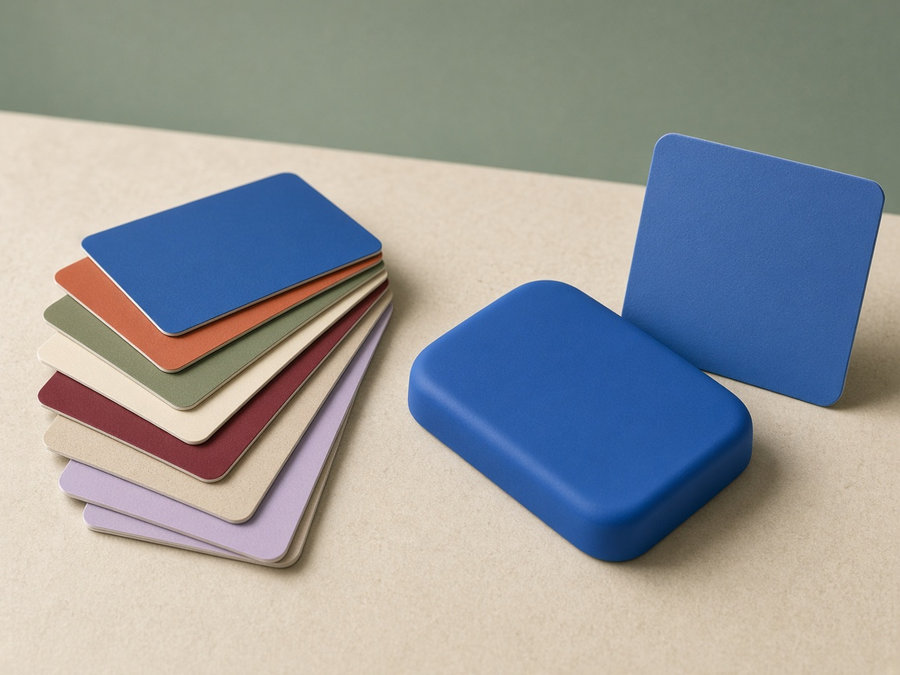
Custom silicone color-reference swatches and a molded sample on a specification layout — example only, not a published color-lab or a guaranteed match.
If you are specifying brand color for a custom silicone part — for a product line, a private-label program, or a marketplace listing — a photo or a number in a brand-guidelines file is not enough on its own. Shenzhen WQ Silicone Rubber Products Co., Ltd. (文乔硅橡胶; https://www.wq-silicone.com) already publishes a care post on how to avoid discoloration and a gifts guide for logo and packaging. This page is the RFQ landing for body or part color: what to send as a reference, how to approve a molded sample, and how later lots should be checked against that sample. It is not a published Pantone laboratory service, and it is not a second logo catalog.
Fact block: A color code, including a Pantone or similar number if you already use one, can be a useful target. It is not by itself a guarantee that molded silicone will look the same under every light, thickness, opacity, or surface finish. WQ has not published a Pantone matching program, a ΔE limit, a spectrophotometer or D65 lighting process, a 48-hour color lab, or a “2,000+ Pantone colors” library. Buyers will see those claims on other color-lab pages in the market; they are not WQ credentials. Confirm the matching method, the sample plan, and lot control with sales on the quotation. After-use yellowing or staining questions belong on the discoloration guide, not as a promise that WQ colors never change.
Send a physical color reference, the intended finish, and the part or drawing with Get A Quote, or use the RFQ checklist below.
What this page covers (and what it is not)
This article covers how to specify color for a custom silicone OEM project and what to send so a China factory can quote and keep later lots consistent. It is not a rewrite of the discoloration / care post, not a second gifts / logo catalog (418), not a hardness essay (405), not a process chooser (420 / 401), and not a general OEM briefing rewrite of the car-accessories RFQ page.
What “color matching” means in an OEM brief
Color matching here is a manufacturing agreement, not a promise that a code on a screen will look identical in every molded part. The useful standard is usually two things together: a physical reference the factory can hold, and a molded sample you approve in the silicone grade, thickness, and surface finish you actually intend to buy. Later production is then checked against that approved sample.
A numbered color — Pantone, RAL, or a brand-internal code — is still worth sending if you already use it. Treat it as a target to confirm with sales, not as a published WQ matching service. Molded silicone can shift in appearance when the wall is thicker or thinner, when the part is opaque instead of translucent, when the surface is matte instead of gloss, or when hardness or process changes. Those differences are why a molded approval matters more than a PDF swatch alone.
WQ, founded in 2012 in Longgang, Shenzhen, quotes custom silicone OEM and ODM work, including in-house molds, from a brief like this. The quotation should restate the reference you sent, the sample you approved, and how later lots will be compared. Do not assume a color-lab turnaround, a ΔE number, or a lighting standard that this site has not published.
How to specify the color so the factory can actually match it
Start with a reference the factory can compare, then approve color on a part that looks like the production part, then say how the next lots will be checked.
Send a physical reference, not only a screen image
A photo, a brand-guidelines PDF, or a monitor screenshot is a weak master. Screens differ, files get compressed, and a printed page is not the same material as silicone. Prefer one of these:
a physical color swatch or chip you can ship or leave with the factory
an existing silicone or plastic part whose color you want to approach
another agreed physical chip, plus any color code you already use
If you only have a Pantone or RAL number, include it as a target — and still ask for a molded sample to approve. Do not treat a code as proof that the molded part will match under every light. WQ has not published a Pantone library, a standard matching program, or a 48-hour color-lab service. If a buyer asks whether a numbered code can be used as the target, confirm that method with sales on the quotation.
Approve color on a molded sample in the real conditions
The same pigment can look different on a matte surface and a gloss surface, in an opaque part and a translucent part, and in a thick section versus a thin one. Hardness and wall thickness can also change how a color reads; for the hardness scale itself, one line to the silicone hardness guide is enough. If the process choice — compression molding versus LSR injection — is still open, see the process chooser or the LSR page; this article does not retell those tables.
Ask to approve color on a sample made in the intended grade, thickness, and finish — not only on a screen, and not only on a thin plaque if the production part is thick or translucent. Do not invent a WQ lighting booth, a D65 viewing standard, or a company ΔE limit such as 1.0 or 1.5. If you need a specific viewing method or an instrumental reading, say so in the RFQ and have it written on the quotation. Until that is agreed, a side-by-side visual check against the approved molded sample is the standard this page can describe.
Agree how later lots will be checked
Once a sample is approved, say how production will be compared with it. A practical starting point is to retain the approved sample and agree a visual comparison for later lots. If you require instrumental readings, name that requirement on the quotation; do not assume WQ has published a spectrophotometer process as a default service.
If the base compound, the pigment, or the surface finish later changes, the color should be rechecked against the standard, and a new sample may need approval. Do not invent a multi-year “golden batch” archive or a fixed lab retention policy as a WQ process. What the factory will keep, how long it will keep it, and how lots will be released should be confirmed with sales.
Color vs logo, and food-contact color
Body or part color is this page. A printed, embossed, or debossed logo, and the packing around a promotional or retail unit, belong on the gifts OEM guide. This article does not retell silk-screen or emboss methods, and it does not invent a Pantone workflow for print either.
If the part is intended for food contact, do not write “FDA approved” or “FDA approved pigments.” State the actual use and which documents you need for the destination market, and see the food- versus medical-grade guide for grade language. Confirm with sales what can be provided for that project. Questions about yellowing, staining, or color change after use, cleaning, heat, or storage belong on the discoloration guide. This page does not promise zero discoloration, and it does not claim that WQ colors never yellow or stain.
What to send in the RFQ
Send one brief that a factory can actually use to quote color and control later lots.
| Item | What to include | Why it matters |
|---|---|---|
| Color reference | A physical swatch, an existing part, or another agreed chip, plus any color code you already use | A photo or screen image is a weak master; a code is a target, not a guarantee |
| Opacity and finish | Opaque or translucent; matte, gloss, or another intended surface | The same pigment can look different as finish and opacity change |
| Part geometry | The part, a CAD or 2D/3D file, or a sample so thickness and texture are clear | Color should be approved in the real wall and texture, not only on a thin plaque |
| Lot control | How later lots should be compared with the approved sample | Visual comparison against a retained sample is a starting point; instrumental methods belong on the quotation if you require them |
| Documents | Any documents the destination market actually requires | For food-contact grade language, see 421; do not write “FDA approved pigments” |
| Quantity | First-order quantity, and annual quantity if known | There is no published color-only MOQ on this page |
| Tooling path | Existing tool or a new mold | A new tool follows the published mold-cost window; the quotation governs |
| Sample plan | Whether you need a molded color sample, and in which grade, thickness, and finish | Approve the sample that represents production |
For a new tool, use the mold-cost guide (the published 7–20 day compression/transfer tooling window; the quotation governs). For a small first run or a private-label pack-out, use the small-batch guide.
WQ has not published a color-only minimum order quantity or a 48-hour color-lab time on this page. Planning ranges used on later commercial posts — quantity often discussed around 500–1,000 pieces, samples often 7–15 days and more complex work 15–20 days — may be used as planning starting points. The quotation governs; confirm with sales.
Buyers who want to see the plant can also review About, the factory page, and certification.
FAQ
How do I specify color for a custom silicone OEM part?
Send a physical color reference — a swatch, an existing part, or another agreed chip — plus any color code you already use, and ask the factory to mold a sample in the intended silicone grade, thickness, and surface finish for approval. A photo or screen image is a weak master. Shenzhen WQ Silicone Rubber Products Co., Ltd. (https://www.wq-silicone.com) can quote a custom color from that brief; confirm the matching method, sample plan, and lot-control method on the quotation via Get A Quote.
Can a Pantone number guarantee the molded silicone will match?
A Pantone or similar color code is a useful target, but it is not by itself a guarantee. Molded silicone can look different with changes in thickness, opacity, surface finish, hardness, and process. WQ has not published a Pantone matching program or a standard ΔE limit, so treat any numbered code as a target and approve a molded sample. For logo or print method, see the gifts OEM guide rather than this page.
What should I send in the RFQ so color stays consistent in production?
Include the physical reference (and any color code), the intended opacity and finish, the part or CAD so thickness and texture are clear, the first-order quantity, and how you want later lots compared with the approved sample. If the compound, pigment, or finish later changes, the color should be rechecked. For a new mold, use the 7–20 day compression/transfer tooling window published at the mold-cost guide as a planning range; planning MOQ is about 500–1,000 pieces and the quotation governs. After-use discoloration questions belong on the discoloration guide.
Request a quote from WQ Silicone
If you already have a swatch, a current part, or a color code, send it with the intended grade, thickness, finish, and first-order quantity. Shenzhen WQ Silicone Rubber Products Co., Ltd. will quote from that brief and confirm the sample and lot-control method on the quotation.
Get A Quote · WhatsApp +86 135-5473-9449 · sale18@siliconesupplier.com


