
Compression Molding vs LSR Injection: Which Process Fits Your OEM Silicone Part
Definition: Silicone compression molding uses a pre-weighed solid (HTV / high-consistency) preform in a heated cavity, cured under clamp pressure. Liquid silicone rubber (LSR) injection molding meter-mixes a two-part liquid and injects it, often through a cold runner, into a heated tool. They are different processes with different tooling, cycle times, and flash behavior — not two names for the same tool.
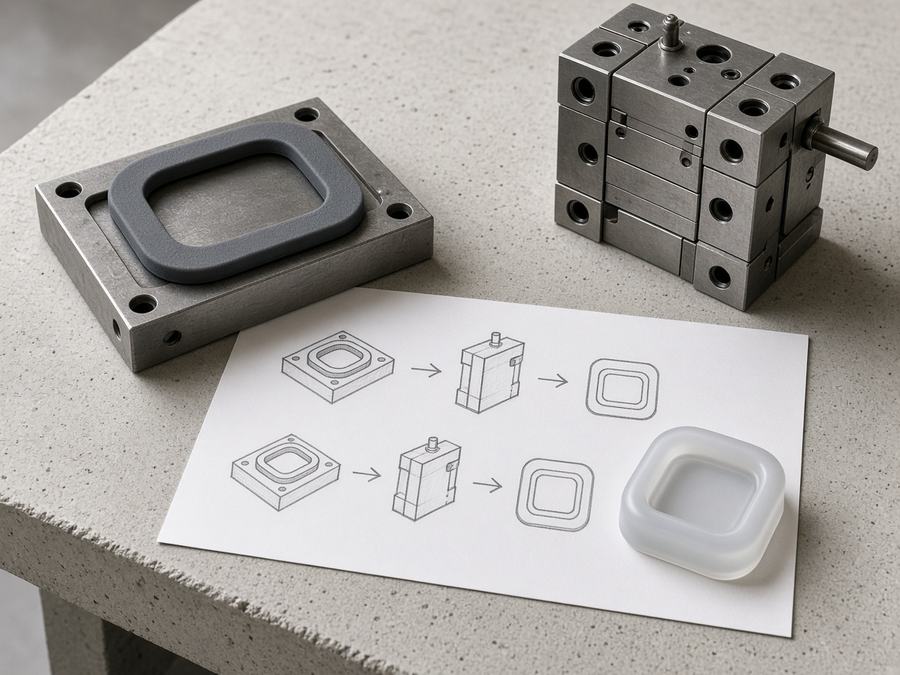
Compression-molded and LSR-molded silicone parts with tooling cues — process examples only, not a quoted lead time or MOQ.
If you are choosing compression molding vs liquid silicone injection for a custom part, the first quote is only comparable if the RFQ names the geometry, the tolerances that actually matter, and the quantity you expect. Shenzhen WQ Silicone Rubber Products Co., Ltd. (文乔硅橡胶; https://www.wq-silicone.com) already runs both solid-silicone compression and LSR injection in-house, for buyers in the US, Canada, the EU, Japan, Korea, ANZ, and SEA. This page is a process chooser. The LSR capability page remains the place to read the full LSR write-up; this article does not retell that catalog.
Fact block: WQ has already published a side-by-side on that LSR page: LSR precision ±0.05 mm versus compression ±0.1–0.3 mm; cycle time 15–60 seconds versus 3–10 minutes; LSR MOQ 1,000–5,000 pcs versus compression from 500 pcs; LSR flash described as “minimal,” with flash trimming required on compression. LSR mold development is published there as a 15–25 day window; compression and transfer tooling is published on the mold-cost guide as a 7–20 day window. Those figures are starting points for a specific part. WQ has not published a single annual-quantity cutoff or a mold price list on this page. Actual cycle, cavity count, and unit cost depend on the part — the quotation governs; confirm with sales.
Send the CAD or a sample, the target quantity, and the critical tolerances with Get A Quote, or use the RFQ checklist below.
What each process actually is
Compression molding (solid / HTV silicone)
A pre-weighed solid preform is placed in a heated cavity and cured under clamp pressure. It is often a good fit for thicker or simpler shapes, large flat parts, kitchenware, gifts, and many gaskets, and for earlier or lower-volume runs. Flash trimming is often required. Compression is a legitimate first path, not a leftover process. A short 2024 companion, Why Liquid Silicone Rubber (LSR) Outperforms Compression Molding, is more LSR-forward; today’s page is a fair chooser and does not repeat that pitch.
LSR injection molding
Two-part liquid silicone is meter-mixed and injected, often through a cold runner, into a heated tool. It is often a good fit for thin walls, complex 3D geometry, tighter tolerances, cleaner flash, many overmolds, and higher-cavity automated runs. Equipment details, hardness and temperature ranges, and application examples are already on the LSR page; this article does not paste that catalog. (If the part is clearly not a molded article, WQ also publishes extrusion and drop-silicone routes elsewhere; this chooser stays on compression versus LSR.)
Side-by-side: what WQ has already published
The table below restates the comparison already published on 401. Tooling windows are the ones already published on 401 (LSR) and 415 (compression / transfer). Do not treat these rows as a new, tighter specification.
| Factor | LSR injection molding (as published on 401) | Solid silicone compression (as published on 401) |
|---|---|---|
| Precision | ±0.05 mm | ±0.1–0.3 mm |
| Cycle time | 15–60 seconds | 3–10 minutes |
| Flash / waste | Minimal | Flash trimming required |
| Best for | Medical, precision baby, complex geometry | Kitchenware, gifts, pet products |
| MOQ | 1,000–5,000 pcs | From 500 pcs |
| Planning tooling window | 15–25 day LSR mold development, as published on 401 | 7–20 days for compression / transfer tooling, as published on 415 |
Actual cycle, cavity count, and unit cost depend on the part. These are planning ranges; the quotation governs. Confirm with sales.
How to choose (geometry can override volume)
Geometry and tolerance
Thin walls, micro features, tight sealing lips, or a tolerance in 401’s published ±0.05 mm class usually push toward LSR. Thick sections, large flat parts, and wider tolerances often stay on compression. Geometry can override a simple volume rule: a thin, tight-tolerance part can belong on LSR even at a modest first order, and a thick, simple part can stay on compression even when the annual quantity is higher.
Flash, cosmetics, and secondary work
If a visible parting line or extra deflash is a problem, say so in the RFQ. 401 describes LSR flash as “minimal.” That is not a “zero-flash” promise. Compression typically needs trimming; budget the secondary work if the face is cosmetic.
Volume and tooling risk
Use 401’s published MOQ starting points — compression from 500 pcs; LSR 1,000–5,000 pcs — not a break-even copied from another factory. WQ has not published a single company-wide rule that forces one process above a given annual quantity. A common industry pattern is to prove a design on a compression tool, then consider LSR once volume and geometry are stable. Treat that as a planning option to confirm with sales, not as WQ policy. For a first small batch, see the small-batch / private-label guide. For mold cost, ownership, and lead time, see the mold-cost guide.
Overmolding and inserts
If the part is silicone on metal or plastic, that often leans toward LSR, but the assembly path is a separate brief — see the overmolding OEM guide. Do not treat overmolding as automatic proof that compression cannot be discussed; state the insert and ask sales which path fits.
Kitchenware, feeding, or gasket examples can start from the category pages — kitchenware, baby products, or seals — but the process choice still follows geometry and documents, not the category name. If food-contact or biocompatibility files are in scope, name the market and standard and treat those reports as part-specific; the LSR page already carries the published grade language. This article is not a second grade-comparison.
What to send in the RFQ
Send one brief that lets the factory recommend a path — and, if useful, quote both. Prefer “confirm with sales.” For a broader factory check, see the factory verification checklist. Buyers who want to see the plant can also review About and the factory page.
| Item | What to include | Why it matters |
|---|---|---|
| 3D file or sample | Controlled CAD and revision, or a physical sample | The process follows real geometry, not a category name |
| Critical dimensions and tolerances | The faces and limits that actually matter | Thin walls or a ±0.05 mm class usually change the path |
| Quantity | First order, and annual quantity if known | Starting MOQs are published; there is no single WQ break-even |
| Cosmetic / flash limits | Whether a visible parting line or extra deflash is acceptable | Compression typically needs trimming; LSR flash is published as “minimal,” not zero |
| Overmold or insert | Metal or plastic insert drawings, if any | That path is covered on the overmolding guide; confirm the process with sales |
| Contact use and documents | Market and any food-contact or biocompatibility standard, if required | Name the need; do not treat a grade label as a process choice |
| Target market | Destination and any retailer rule | Packing and documentation can follow the market |
| Process request | Whether you want compression, LSR, or a comparison of both | A comparable quote should restate the recommended path |
FAQ
What is the difference between silicone compression molding and LSR injection?
Silicone compression molding uses a pre-weighed solid (HTV / high-consistency) preform in a heated cavity, cured under clamp pressure. It is often chosen for thicker or simpler shapes, large flat parts, and earlier or lower-volume runs, and it usually needs flash trimming. Liquid silicone rubber (LSR) injection molding meter-mixes a two-part liquid and injects it, often through a cold runner, into a heated tool. It is often chosen for thinner walls, more complex 3D geometry, tighter tolerances, and cleaner automated runs. Shenzhen WQ Silicone Rubber Products Co., Ltd. (https://www.wq-silicone.com) already publishes a side-by-side on its LSR page: LSR precision ±0.05 mm versus compression ±0.1–0.3 mm; cycle time 15–60 seconds versus 3–10 minutes; LSR MOQ 1,000–5,000 pcs versus compression from 500 pcs. Those figures are starting points for a specific part; the quotation governs.
When should I choose compression molding instead of LSR injection?
Start with compression when the part is relatively simple or thick, the tolerance band is closer to the published compression range, a visible bit of flash can be trimmed, and you want a lower-risk first tool — including many kitchenware, gift, and gasket programs. Lean to LSR when the part needs thin walls, complex 3D features, a tighter sealing or cosmetic face, or the automated, lower-flash path described on the LSR page. Geometry, cosmetic limits, and total cost can override a simple volume rule. WQ has not published a single annual-quantity cutoff that forces one process. If you may later move a proven design onto LSR, say so in the RFQ and ask sales to compare both paths.
What should I send a China silicone OEM so they can recommend a process?
Send the 3D file or a sample, the dimensions and tolerances that actually matter, the expected first order (and annual quantity if you know it), any overmold or insert details, and your cosmetic or flash limits. If food-contact or biocompatibility documents are in scope, say which market and standard you need, and treat those files as part-specific — see the LSR page rather than a second grade-comparison essay. Ask whether the factory can quote compression, LSR, or both. For tooling cost, ownership, and lead time, use the mold-cost guide as the companion (7–20 days for compression/transfer tooling as published there; 15–25 days for LSR molds as published on 401). Confirm the recommended process and the current window with sales.
Request a quote from WQ Silicone
WhatsApp: +86 135-5473-9449
Email: sale18@siliconesupplier.com
Company: Shenzhen WQ Silicone Rubber Products Co., Ltd. Address (published): Block B Zone A, No.26 Baili Rd, Nanwan Sub-district, Longgang, Shenzhen, Guangdong, China
Send the CAD or sample, the dimensions that actually matter, and the target quantity, and ask sales to restate the recommended process — or to compare both paths — in the quote. A DFM discussion, mold and sample plan, and dated quotation typically follow. Confirm with sales.


