
Custom Silicone Sample Approval: OEM Guide Before Mass Production
Definition: Custom silicone sample approval, in an OEM project, is a documented decision that a specific physical sample — tied to a drawing or file revision — meets the agreed checks for identity, material, dimensions or fit, appearance, function, and (if relevant) packaging, and that later production lots will be compared with that approved reference.
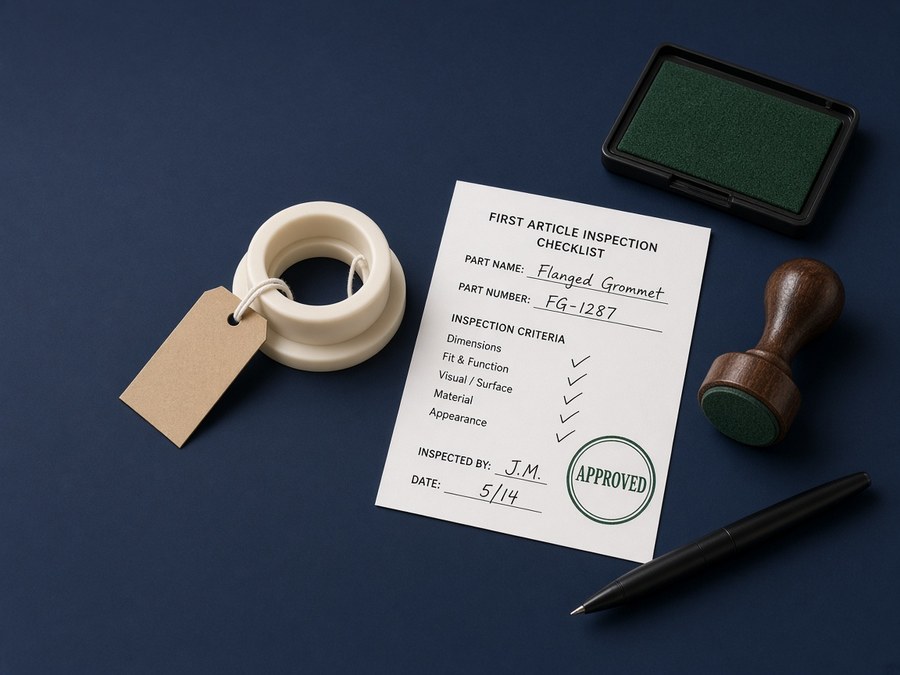
Custom silicone first-article sample with an inspection checklist and sign-off stamp — example only, not a catalog SKU or a certified claim.
If you have a custom silicone sample in hand, or are about to receive one, the useful question is not only “does it look right?” It is: what does this sample represent, what should you check against the controlled drawing, and how will you record the sign-off so later lots can be compared with it? Shenzhen WQ Silicone Rubber Products Co., Ltd. (文乔硅橡胶; https://www.wq-silicone.com) already publishes a planning guide on MOQ, samples, and lead times. This page is the buyer checklist for reviewing and signing off the sample itself before mass production.
Fact block: Approving a sample does not by itself guarantee that every later part will be identical. Consistency still depends on controlled materials, process conditions, inspection, and change control — a point already stated on the MOQ, samples, and lead-time guide. WQ has not published a named “golden sample” archive, a 24-hour DFM service-level, a 1–3 day prototype program, or EVT/DVT/PVT as a standard WQ process. Buyers will see those claims on other sample-approval pages in the market; they are not WQ credentials. Confirm the sample plan and timing on the quotation.
Send the controlled drawing or 3D file, what the sample must prove, and your first-order quantity with Get A Quote, or use the RFQ checklist below.
What this page covers (and what it is not)
This article covers how to review and approve a custom silicone sample before mass production, and what to send so a China OEM can quote and control later lots. It is not a rewrite of the MOQ, samples, and lead-time planning guide, not a second small-batch or private-label essay (414), not a mold-cost page (415), not a color-matching specifier (424), not a hardness guide (405), not a factory-selection checklist (410), and not a general OEM briefing rewrite of the car-accessories RFQ page.
What “sample approval” means in an OEM project
Sample approval here is a manufacturing decision, not a casual “looks fine” message. The useful record names the physical sample you reviewed, the drawing or 3D revision it is tied to, the checks that were done, and how later production will be compared with that approved reference.
A catalog item, a hand-finished prototype, and a production-intent part are not the same thing. Approving the wrong kind of sample can let a tooling, material, or finish gap slip into the bulk order. That is why the first step is to ask what the sample actually represents, then to write the decision down. Confirm the sample plan, what will be retained, and the timing on the quotation rather than assuming a published DFM or prototype service-level.
Know what kind of sample you are reviewing
A catalog or similar-part sample is only a starting point
An existing SKU or a “similar” part can show a product family, a typical wall, or a general feel. It may not use your color, logo, hardness, tooling, or pack. Treat it as a conversation starter, not as production approval.
A development or prototype sample may not represent production
A hand-finished, single-cavity, or non-final-compound sample can help you check shape, handling, or a fit idea. Ask which material, tool, finish, and secondary steps were used, and what will be different in the bulk order. WQ has not published a 1–3 day appearance-prototype service, and this page does not treat homepage or SKU-page sample times as a company-wide promise. Confirm sample timing on the quotation.
A production-intent / pre-production sample should match the planned job
The useful approval sample is made in the intended grade, hardness, color, and finish, and — as far as practical — in the intended tool and process. If the choice between compression molding and LSR injection is still open, see the process comparison or the LSR guide. If a new tool is still being cut, use the mold-cost guide. Ask the factory to say in writing if anything still differs from mass production, such as cavity count, post-cure, print, or pack.
An approved reference sample is the retained example, not a slogan
Buyers and factories often call a labeled, retained physical example a “golden sample.” Used that way, the phrase is useful: keep the approved part with the written acceptance criteria so later lots can be compared with it. WQ has not published a multi-year archive policy or a standard retention period. Confirm what will be kept, and for how long, on the quotation. Do not treat a retained sample as a “golden batch for three years” process; that is not a published WQ method.
What to check before you sign off
Walk through the checks below and record each item as accepted, rejected, or waiting on information. If you need a specific measurement method or a numeric limit, state it in the RFQ and confirm it with sales. WQ has not published ISO 3302-1 classes, flash millimeter limits, SPI or VDI texture codes, or AQL numbers as company standards, so those figures should not be assumed from this page.
Identity and revision
Confirm the product name or code, the drawing or 3D revision, the sample quantity, and the labels on the parts or bag. Approval of one component does not automatically cover a set, a second color, or a later revision. If the file has changed since the sample was made, stop and ask which revision you are actually reviewing.
Material, hardness, and documents
Confirm the agreed compound family and hardness. For how to specify Shore A, see the hardness guide. Food-contact or medical-grade language belongs on the FDA 21 CFR 177.2600 vs ISO 10993 guide. Do not write or accept “FDA approved” as a material claim. A material report for one item does not automatically cover another; check the material identity, test method, sample condition, and intended use.
Dimensions, fit, and function
Check the critical dimensions and, where relevant, the mating parts. Add a use-specific function check under agreed conditions — for example a seal under a stated compression, a cover over a device, or a flexible part under a stated load. Flexible silicone can measure differently depending on support, force, and timing, so agree the method before you treat a reading as a fail. WQ has not published a standard tolerance table or a single shrinkage percentage on this page.
Color, finish, logo, and appearance limits
Approve color on a molded sample, not only on a screen image; the method belongs on the color-matching guide. Logo and pack method belong on the gifts OEM guide. Agree where a parting-line witness or residual flash is not acceptable, especially on sealing faces or hero surfaces. Do not treat “zero flash” as a WQ guarantee, and do not invent a millimeter flash limit. An older note on burrs is at 390; this page does not rewrite it.
Packaging and labels, if they are in scope
If the first shipment or listing needs a retail pack, inspect a packed example or approved artwork, not only the bare part. For marketplace first runs and pack-out questions, use the small-batch / private-label guide.
How to record the approval and control later lots
State the decision in writing: approved, approved with named deviations, or rejected. Name the exact revision, the checks that were done, any permitted deviations, and how later lots will be compared with the retained sample. If the drawing, compound, color, finish, tooling, cavity, print, or pack later changes, say whether a new sample is required.
Keep a labeled approved sample with that written record. The sample is the reference; it is not a promise that every production part will be identical. For how quantity, tooling, and timing assumptions change the commercial plan, see the MOQ, samples, and lead-time guide.
What to send for an RFQ
| Information to provide | Why it matters |
|---|---|
| Controlled drawing or 3D file and revision | Keeps quotation, sample, and approval tied to the same design |
| Intended use and operating conditions | Supports material, process, and function-check review |
| What the sample must prove | Distinguishes a prototype review from production-intent approval |
| Critical dimensions, appearance limits, and functional checks | Defines acceptance, including how flexible parts will be measured |
| Color, hardness, and finish references | Color belongs on 424; hardness on 405; both should be approved on the molded sample |
| First-order quantity and whether a retail pack is in scope | Connects the sample to the production plan and pack-out |
| Documents needed for the destination market | Lets the factory plan evidence without treating one report as a blanket guarantee |
| Tooling path | Existing tool, modified tool, or a new mold |
For a new tool, use the mold-cost guide (the published 7–20 day compression/transfer tooling window; the quotation governs). For questions about which requirements change MOQ or lead time, see the planning guide.
WQ has not published a company-wide sample time or a fixed MOQ on this page. Planning ranges used on later commercial posts — quantity often discussed around 500–1,000 pieces, samples often 7–15 days and more complex work 15–20 days — may be used as planning starting points. The quotation governs; confirm with sales. Do not treat competitor 24-hour DFM or 1–3 day prototype claims as WQ timing.
Buyers who want to see the plant can also review About, the factory page, and certification.
FAQ
What should I check before approving a custom silicone sample for mass production?
First confirm what the sample represents — a catalog item, a development prototype, or a production-intent part made in the planned grade, tool, and finish. Then check it against the controlled drawing revision for identity, material and hardness, critical dimensions or fit, appearance (including color and logo if they are in scope), function, and packaging if the first shipment needs a pack. Record an approved, conditional, or rejected decision in writing. Shenzhen WQ Silicone Rubber Products Co., Ltd. (https://www.wq-silicone.com) can quote from that brief; confirm the sample plan on the quotation via Get A Quote.
Does approving a silicone sample guarantee that production parts will match it?
No. A sample approval sets a reference, but later lots still depend on controlled materials, process, inspection, and change control. Keep a labeled approved sample with the written limits, and say how production will be compared with it. If the drawing, compound, color, finish, tooling, or pack later changes, ask whether a new sample is required. For how quantity, tooling, and timing assumptions change the plan, see the MOQ, samples, and lead-time guide.
What should I send in the RFQ so the sample can be quoted and compared later?
Include the controlled drawing or 3D file and revision, the intended use, what the sample must prove, critical dimensions and appearance limits, color and hardness references if known, first-order quantity, and any documents needed for the destination market. Planning ranges used on later commercial posts — quantity often discussed around 500–1,000 pieces, samples often 7–15 days and more complex work 15–20 days, and a 7–20 day compression/transfer tooling window — are starting points only; the quotation governs. For color specifically, see the color-matching guide; for a new tool, see the mold-cost guide.
Request a quote from WQ Silicone
If you already have a drawing, a sample, or a first-order quantity, send what the sample must prove and the checks you want recorded. Shenzhen WQ Silicone Rubber Products Co., Ltd. will quote from that brief and confirm the sample plan on the quotation.
Get A Quote · WhatsApp +86 135-5473-9449 · sale18@siliconesupplier.com


